

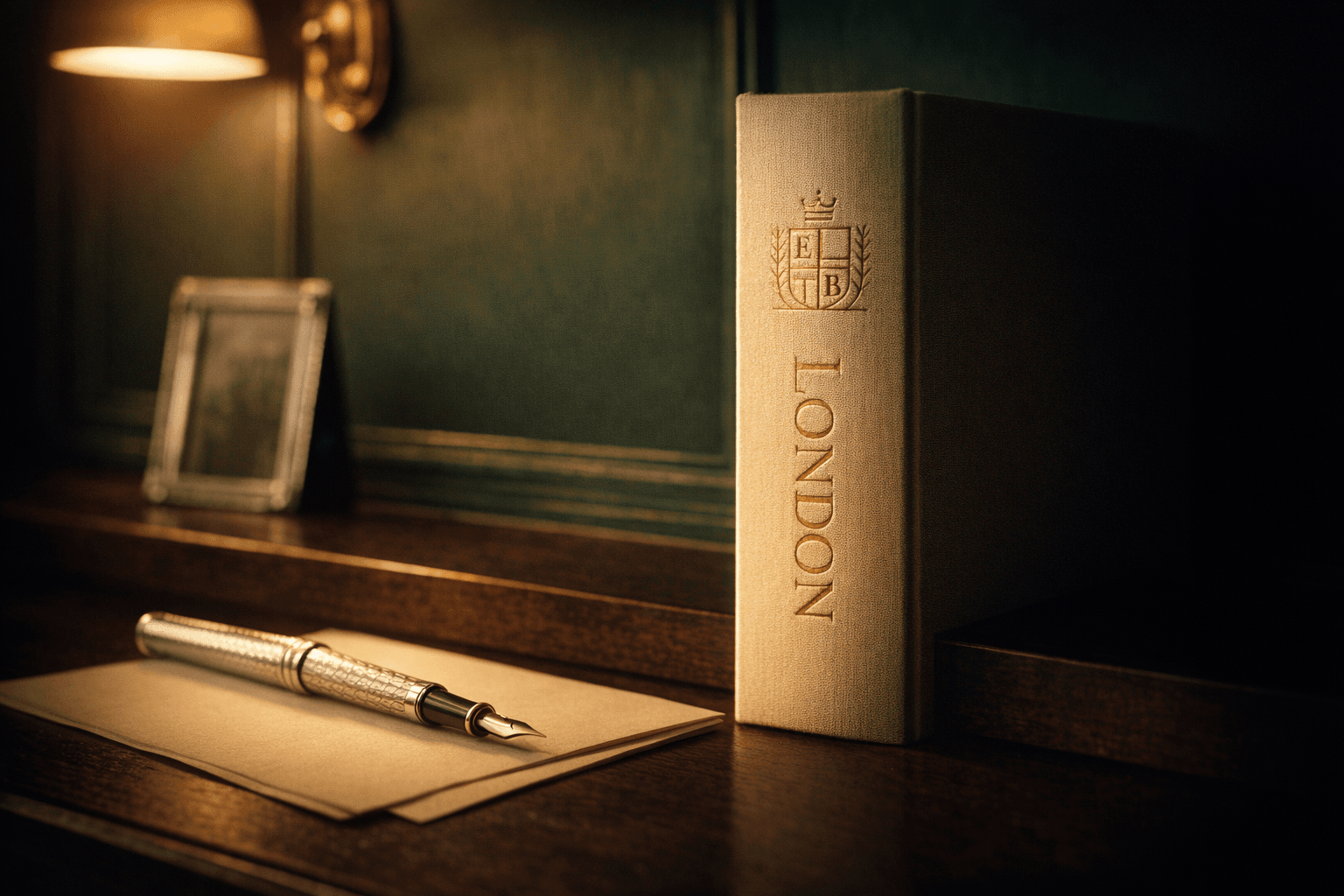
The Language of British Luxury: A Collector's Glossary
The Language of British Luxury: A Collector's Glossary
There is a particular vocabulary that surrounds British luxury goods, one that carries centuries of craft tradition, regulatory precision, and cultural meaning. For international collectors acquiring pieces from the United Kingdom, whether from the UAE, the United States, or Australia, understanding these terms is not merely an exercise in linguistics. It is the foundation of informed acquisition, and the difference between purchasing a genuine heirloom and simply buying an expensive object.
What follows is a guide to the key terms and concepts that define British luxury, drawn from the categories we work with daily at EB London: sterling silver, handcrafted furniture, fine art, and premium lighting.
Sterling Silver and the Hallmarking System
Perhaps no term in British luxury is more precisely regulated than sterling silver. In the United Kingdom, sterling silver must contain a minimum of 92.5% pure silver, with the remaining 7.5% typically copper for structural integrity. This is not a marketing claim; it is a legal standard enforced by the British Assay Offices, which have operated continuously since the 13th century.
Every piece of sterling silver sold in the UK carries a hallmark, a series of stamps applied by an independent Assay Office confirming the metal's purity, the year of production, and the maker's identity. When you acquire a Yard-O-Led fountain pen or a Carrs Silver photo frame, the hallmark is your guarantee of provenance and authenticity. No reputable British silversmith would offer a piece without one.
The term silversmithing itself refers to the specific craft of working with silver to create functional or decorative objects. It is distinct from jewellery-making in its scale and tradition, and Britain's silversmithing centres, particularly Birmingham's Jewellery Quarter where Yard-O-Led has operated for over a century, remain among the most respected in the world.
Handcrafted vs. Hand-Finished: A Critical Distinction
International buyers sometimes encounter these two terms interchangeably, which is a significant misrepresentation. Handcrafted denotes that a skilled artisan constructed the object by hand, making individual decisions throughout the process. Hand-finished means the object was largely machine-produced, with human intervention only at the final stage.
This distinction matters enormously at the level of quality we curate. The Saxon Premium upholstered furniture pieces in our collection, including footstools and ottomans produced in England, are genuinely handcrafted. Each piece is built by craftspeople who cut, shape, and upholster the material individually. The result is an object with subtle character and structural integrity that no production line can replicate.
When a British maker uses the term bespoke, they mean something similarly specific. A bespoke commission is created entirely to a client's requirements, from materials to dimensions to finishing details. It is not a pre-made product offered in a selection of colours. Our concierge sourcing service operates precisely on this basis, working with makers to deliver pieces that match a client's exact specification.
Provenance and Why It Commands a Premium
Provenance is one of the most important words in the luxury goods lexicon, and it is frequently misunderstood. In the strictest sense, provenance refers to the documented origin and ownership history of an object. For collectors, strong provenance serves two purposes: it confirms authenticity, and it supports long-term value.
Within the British context, provenance extends beyond individual ownership records to encompass the heritage of the maker. A CTO Lighting chandelier carries the provenance of a British studio design process, sourced materials of the highest grade, such as honed alabaster and solid brass, and a reputation built across years of work with architects and interior designers internationally. That maker history is as relevant to the object's value as any single ownership record.
Similarly, commissioned artwork carries provenance in the form of the artist's documented output, exhibition history, and professional standing. The works by Kimberley Harris available through EB London are not speculative acquisitions; they are works by an established British artist with a clear and traceable body of work.
Made in England, Made in Britain, and British-Designed
These three phrases are not interchangeable, and buyers should understand the distinctions. Made in England is the more specific claim, indicating manufacture within England specifically. Made in Britain encompasses England, Scotland, Wales, and Northern Ireland. British-designed may indicate conception and creative development occurred in Britain, while production happened elsewhere.
Our collection is built exclusively around goods that are genuinely produced in the United Kingdom. This is a deliberate curatorial decision, not a marketing position. The integrity of the products we offer, from The Saxon Premium furniture collection to Yard-O-Led writing instruments, depends on their manufacture remaining in the hands of British craftspeople working within British ateliers and workshops.
Limited Edition and Its Meaning in Fine Art
For collectors considering fine art prints, the term limited edition carries contractual weight. A genuine limited edition print is produced in a fixed, numbered run, with each print in the edition signed and numbered by the artist. Once the edition is exhausted, no further prints are produced from that iteration.
The Amelia Coward limited edition prints available through our platform follow this model precisely. The edition size is defined, the prints are unframed to allow the collector full control over presentation, and the documentation accompanying each work confirms its place within the edition. For buyers entering the fine art market, this framework protects both the integrity of the work and the collector's long-term investment in it.
Understanding Quickship and Lead Times in British Luxury
A final practical term worth addressing is Quickship, which appears across several pieces in our lighting collection. In the context of bespoke British manufacturing, standard lead times for pieces such as the CTO Lighting Avalon chandeliers can extend to several weeks or months, reflecting the handmade nature of production. Quickship designates items held in stock that can be dispatched with significantly reduced waiting times, without any compromise to the quality of the piece itself.
For international collectors, particularly those furnishing properties on project timelines, understanding lead time terminology allows for more accurate planning and procurement.
The vocabulary of British luxury is, at its core, a language of accountability. Each term carries a specific meaning grounded in centuries of craft regulation, trade law, and artisan tradition. Learning it is the first step toward acquiring with true confidence.
To explore our full collection of British-made interiors, silver, lighting, and art, visit us at eblondon.com.


Leave a comment
This site is protected by hCaptcha and the hCaptcha Privacy Policy and Terms of Service apply.