

Why British Upholstered Furniture Outlasts Mass-Produced Pieces
Why British Upholstered Furniture Outlasts Mass-Produced Pieces
Walk into a home furnished with genuine British upholstered pieces and you notice something immediately. The seats hold their shape. The proportions feel considered. The fabric sits with a tension that suggests it was placed there deliberately, not simply stretched across a frame and stapled in haste. These are not accidents of taste; they are the direct result of how the furniture was built, by whom, and according to what standards.
Mass-produced upholstered furniture dominates the market by volume, and it competes aggressively on price. But it operates on an entirely different philosophy: build quickly, price accessibly, and replace often. British handcrafted upholstery operates on the opposite premise entirely. The goal is not a low price point; the goal is a piece that your grandchildren will still be using.
Understanding why requires looking closely at what separates these two approaches at every stage of construction.
The Foundation: Frames That Last
The structural integrity of any upholstered piece begins with its frame. In mass production, the frame is typically constructed from engineered wood panels, plywood composites, or staple-joined softwood. These materials are inexpensive, quick to work with, and adequate for a short functional lifespan. They are not designed to flex and recover under decades of use.
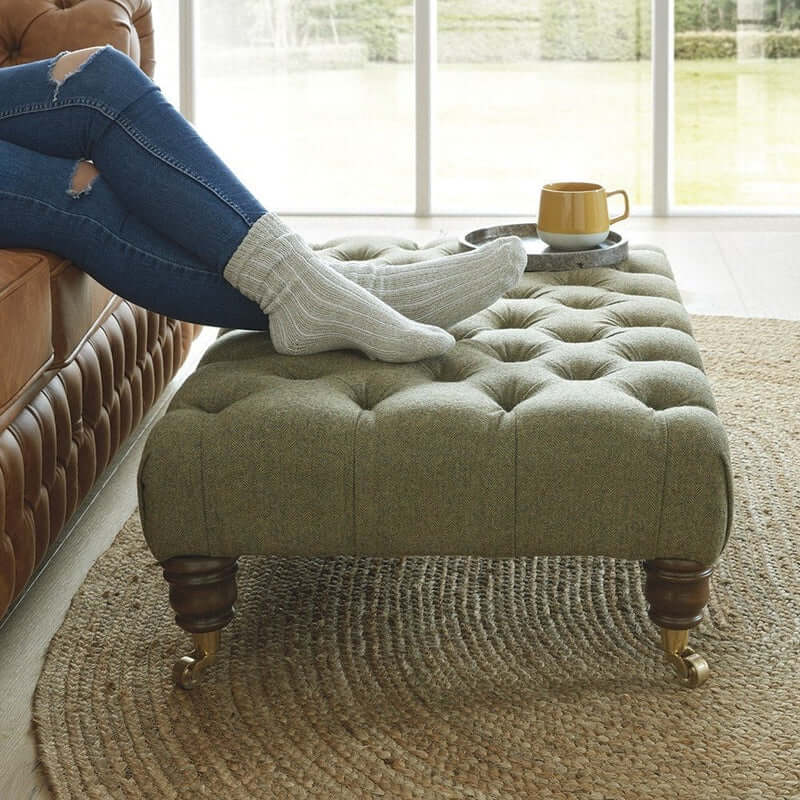
British handcrafted upholstery uses kiln-dried hardwood frames, often beech or oak, cut and jointed by skilled craftspeople. Mortise-and-tenon joints, corner blocks, and hand-glued reinforcements are standard features, not premium upgrades. A hardwood frame built and jointed properly does not rack or warp. It absorbs the stresses of daily use without fatigue. When we consider the Saxon Premium collection available through our curation, pieces like the Harrow Footstool and the Elegant Piccadilly Footstool are built on exactly this principle: frames constructed to serve as heirloom foundations, not seasonal purchases.
Suspension Systems and the Craft of Support
Below the seat cushion, a suspension system determines how a piece feels under use and how well it retains that feeling over time. Mass-produced furniture typically uses sinuous (or serpentine) wire springs, which are inexpensive to install using automated equipment. They do the job initially, but they lack the depth and resilience of traditional alternatives.
Traditional British upholstery relies on eight-way hand-tied coil springs, a technique that requires each spring to be individually positioned, tensioned, and tied by hand in eight directions across the base of the seat. The result is a suspension system that distributes weight evenly, returns to shape consistently, and maintains its performance for decades without sagging. This is time-consuming work that cannot be meaningfully automated, which is precisely why it remains a marker of genuine craftsmanship rather than a claimed feature on a product label.
The Interior Build: Materials Matter Profoundly
Once the frame and suspension are in place, the interior layers determine the long-term comfort and structure of the piece. Mass production relies heavily on high-density foam, which is consistent, predictable, and relatively cheap. It also degrades. Foam breaks down under regular compression, losing both its supportive qualities and its shape, often within five to ten years of regular use.
British handcraft draws on a layered approach developed over centuries. Natural materials including horsehair, wool, and traditional wadding are applied in stages, each layer serving a specific purpose in building up the profile and feel of the seat. These materials compress and recover differently from foam; they breathe, they adapt, and they do not simply collapse. The result is a seating surface that may require gentle attention over the decades but will not fundamentally fail. A piece built this way in 2026 may well be reupholstered in 2056 and remain structurally sound; the frame and interior build will still merit the new fabric.
Fabric, Finishing, and the Detail That Defines Quality
The outer fabric on a mass-produced piece is typically selected for cost and visual impact at the point of sale. Pattern matching is approximate, cuts are mechanically made, and finishing is fast. On British handcrafted pieces, fabric selection is considered from the outset as part of the overall design, and application is painstaking.
Pattern matching on a well-crafted British footstool or ottoman requires the upholsterer to plan each cut so that repeats align across seams, across corners, and across decorative details. Piping, if applied, is cut and sewn by hand. The tension of the fabric across each surface is adjusted individually rather than simply pulled tight and fixed. This level of attention is only possible when a skilled pair of hands is working on a single piece over an extended period of time.
The finishing details on a piece like the Saxon Premium Queen Anne Footstool or the Plain Pouffe Box are not decorative afterthoughts; they are the visible expression of a construction approach that has prioritised quality at every preceding stage.
Why This Matters for Those Who Invest Thoughtfully
There is a commercial reality that surrounds mass-produced furniture that is rarely stated plainly: the business model depends on replacement. Lower prices are possible because the expectation is that the customer will return in five to eight years for another purchase. The furniture industry's volume numbers depend on this cycle.
British handcrafted upholstery breaks this cycle. A piece built on a hardwood frame with hand-tied springs and natural interior materials does not wear out on that timeline. It ages, certainly, and fabric may be refreshed, but the fundamental piece remains. For clients who approach their interiors as a long-term investment rather than a series of seasonal choices, this represents not only better value but a fundamentally different relationship with the objects in their home.
This is why provenance matters. Knowing that a piece was constructed by hand in Britain, using techniques passed down through generations of upholsterers, is not simply a romantic detail. It is a quality assurance with a track record measured in generations rather than years.
We bring exactly this standard of British craftsmanship to clients across the UAE, the United States, Australia, and beyond. Our curated collection and bespoke concierge service exist to connect discerning buyers with pieces that are built to belong in a home for the long term.
If you are considering an investment in genuinely handcrafted British upholstery, or exploring any element of British-made luxury for your interior, we invite you to visit EB London and explore what we have sourced on your behalf.

Leave a comment
This site is protected by hCaptcha and the hCaptcha Privacy Policy and Terms of Service apply.